MAFAC – Almost a century of history
Founded in 1947 in the heart of Auvergne, the Manufacture Arvernoise des Freins et Accessoires de Cycles (Arvernoise Manufacture of Brakes and Bicycle Accessories), or MAFAC, has established itself as an essential reference in the world of cycling. Specializing in the design of braking systems of exceptional quality, MAFAC has left its mark on several generations of cyclists, both amateur and professional. This artisanal expertise, rooted in French tradition, continues to captivate and today inspires enthusiasts of classic bicycles around the world.
1930s – The origins of a visionary craftsman
In the 1920s, Auguste Bourdel, a passionate cyclist and competitor, opened his own bicycle sales shop. Over the course of the 1930s, he expanded his activity by becoming a frame-building artisan, offering bikes with meticulous finishes and incorporating technical improvements and innovations of his own design (double-cable derailleurs, pump locks, etc.).

1946 – The birth of SECURITE brakes
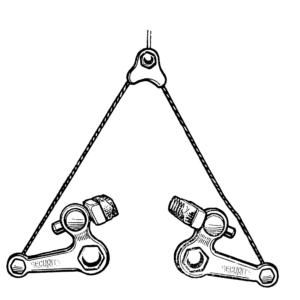
After the war, A. Bourdel worked on improving a center-pull braking system for touring bikes: the Cantilever. After several years of development and the filing of multiple patents, it was in 1946 that the improved version, named “Sécurité,” was brought to market. Its success was immediate.
1947 – Tool kits
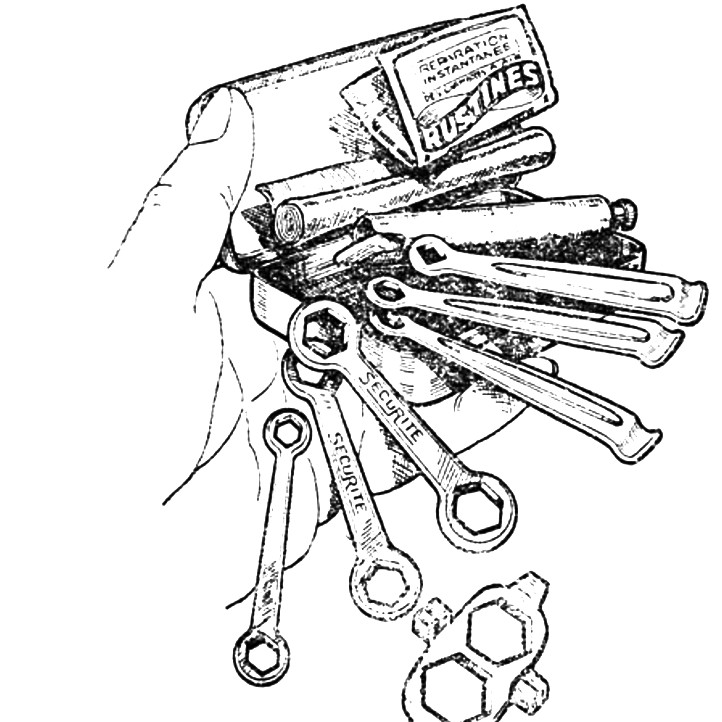
Two years later, A. Bourdel launched for the first time the legendary tool kit (the ancestor of the multitool), still under the Sécurité brand, with its famous slogan: “L’atelier dans la poche” for “The workshop in your pocket.”
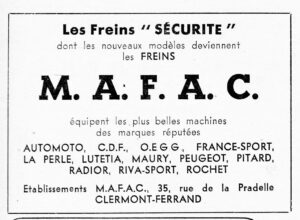
1947 – MAFAC
That same year, for intellectual property reasons, the brakes and tool kits were renamed and are henceforth marketed under the brand M.A.F.A.C. for Manufacture Arvernoise de Freins et Accessoires de Cycle.
1952 – The Rise
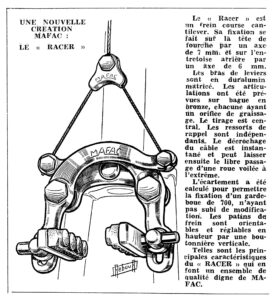
In the following years, Bourdel and his engineers worked on the creation of the center-pull racing brake. This effort led, in 1952, to the Mafac Racer model, which very quickly equipped almost the entire professional peloton, achieving victories in all the major Tours.
1960s – A complete range
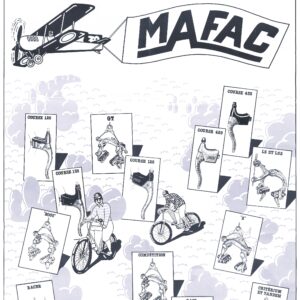
The MAFAC range quickly established itself as an essential reference in the world of cycling, offering brakes suited to all types of bikes: tandems, children’s bikes, women’s models, as well as luxurious versions with gold finishes. Their versatility and reliability appealed not only to enthusiasts but also to the world’s leading manufacturers, who fitted them as standard on their bicycles well into the 1980s..
1950s to 1980s – The Fame
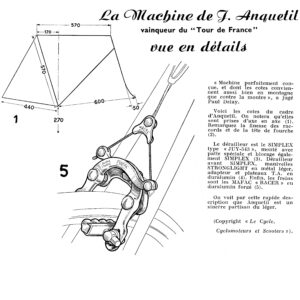
MAFAC also made its mark in competition. The French brand’s brakes equipped the bikes of legendary riders such as Jacques Anquetil, Raymond Poulidor, Bernard Thévenet, and Federico Bahamontes. They can be found on numerous victorious machines in the Tour de France, major classics like Paris-Roubaix and Liège-Bastogne-Liège, as well as World Championships during the 1950s, 1960s, and 1970s. Their power and smooth modulation often made the difference, giving riders crucial control in decisive moments.
Through this continuous presence at the highest level, MAFAC became far more than just a supplier: it became a true technical hallmark of French cycling.
1987 – The End of an Era
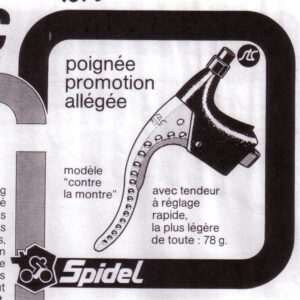
In the 1980s, brands like Shimano and Campagnolo took over by offering complete groupsets (drivetrain + braking) and simpler side-pull brakes. The attempt to compete with these players through the creation of Spidel in 1976 (a merger of the French brands Mafac, Stronglight, Simplex, and Maillard) was not enough. Mafac closed its doors in 1987.
2026 – Preserving a Cycling Heritage
After the disappearance of MAFAC, cyclists and enthusiasts continue to collect and proudly use bikes equipped with these iconic brakes. Unfortunately, the natural rubber used in the brake hoods can deteriorate, jeopardizing the preservation of their precious collections. This is how a historic production reborn …
Follow our latest releases here : NEWS